
Why the Upgrade Feels Like a Downgrade First
Jun 28, 2026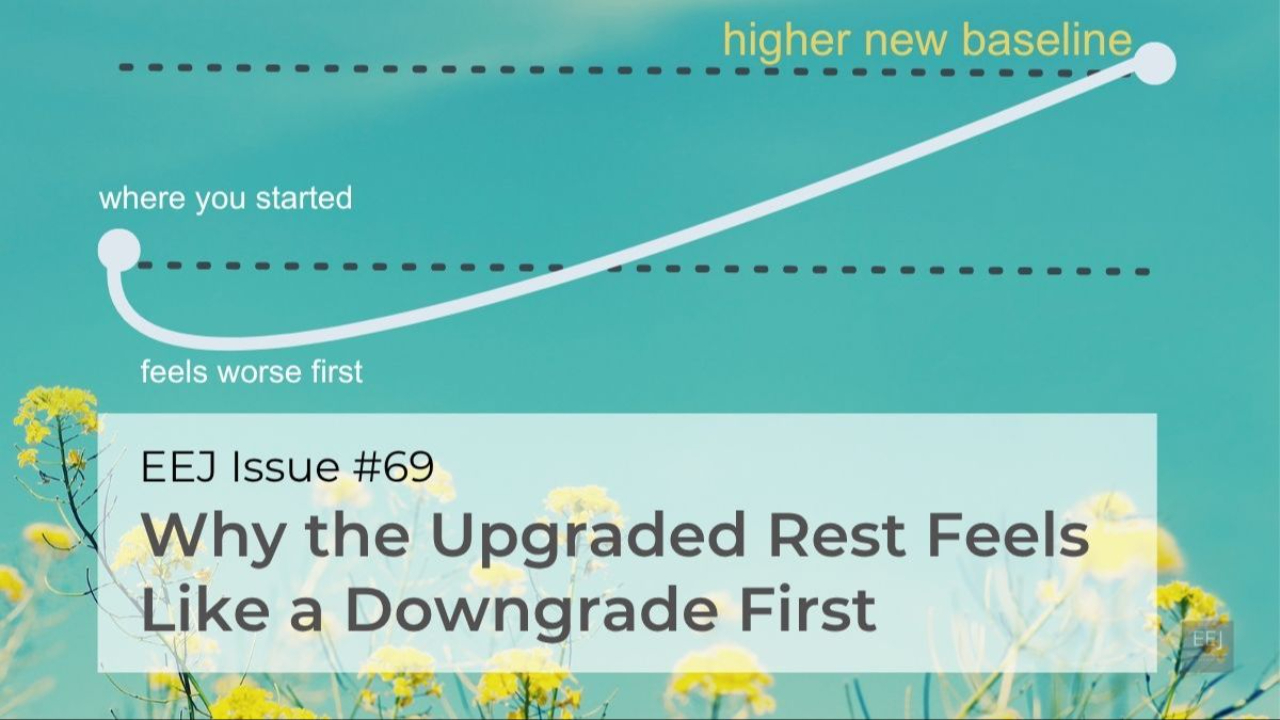
Why the Upgrade Feels Like a Downgrade First
Why the people best at holding the week together are the ones who recover least, and why the move that raises your baseline first registers as losing your grip.
Executive Energy Journal — Issue #69
Welcome to The Executive Energy Journal, written for professionals who choose to lead with purposeful clarity. A grounded, science-informed take on managing subtle energy, spanning from neuroscience to spiritual connection.
How EEJ works
- What's measurable: what research and observable mechanisms support
- What's unknown: where evidence ends, and interpretation begins
- What I do pragmatically anyway: the simplest reliable practice I use with clients
- Your role: take what is useful and leave the rest
You took the time off, and it worked. For a few days.
By the second week back, the tension in your shoulders is there again. You have optimised most of how you operate by now. The calendar, the inputs, the tools, the way you triage a day. This is the one process that has not responded to any of it.
So you reached for the usual fixes, like a longer break next time, a cleaner evening routine. More discipline about switching off. None of them held. What wears you down across a week is less the volume of the work and more the old version of recovery you are still running while the work is happening.
Notice what you do between meetings. You do not put much down. You carry the last conversation into the next one. You keep a line of attention open on the topics that could be closed, just in case. By midweek your system has not fully closed a single loop since Monday. No holiday reaches that. A holiday pauses the input for a while, but it does not touch the process that keeps holding everything open while the input arrives.
1. What the research has already settled
In research terms, recovery is not mainly a matter of time off. It is a capability, a set of internal experiences, and the central one has a name: psychological detachment, the ability to step back from work in your mind and not only in your calendar.
Detachment is the process that actually restores the system, and it is built to run in the rhythm of ordinary days, in the small gaps, rather than batched into one release a year.
That is also why the holiday faded. The vacation studies show the gains in health and well-being are real, and that they slip back toward baseline within the first week of returning to work. The within-day research points to the gaps instead: short recovery taken inside the working day predicts how you feel by the afternoon.
The literature also says something the optimiser in you will recognise. The people who most need to recover are the ones who recover least. High demand does not only tire you. It degrades the very process that would clear the tiredness. Sabine Sonnentag named this the recovery paradox: when the load is highest, the recovery that would answer it is most blocked. The better you are at holding the system together under pressure, the more that same skill stands in the way of the next version of it.
The usual explanation is depletion. You spend the day holding the line, your capacity to choose rest runs thin by evening, and you default to the path of least resistance. True enough, for most people, but in the case of highly perceptive people, It does not reach the specific thing you feel.
Let's pause here. Notice whether your shoulders drop or tighten at the word "rest."
2. The part the evidence cannot reach yet
The depletion story explains the average tired worker. It does not quite explain you.
For a person that registers more than most, the grip is not laziness and it is not weak discipline. It is closer to information management. You hold the thread of the day because letting go of it feels, in the body, like letting something important slip past unnoticed.
Here is the part I want to be precise about, because it is also where the evidence thins.
Every real upgrade has a window where the new way feels worse than the old one. Anyone who has switched a tool they were fluent in knows the dip: the first hours on the better setup are slower, clumsier, faintly alarming, right until they are not. The grip is the old version. It was an upgrade once, the process that got you here, which is exactly why your system trusts it. Releasing it is the new install, and the install runs through a window where the improvement reads, from the inside, as a loss.
What no research instrument analyses yet is the interior of that window. We can measure that detachment fails under load. We can show it tracking with a nervous system that stays switched on long after the trigger is gone.
To my knowledge, there is no clean measure for the split-second when loosening the grip registers as danger rather than relief, the felt certainty that if you stop tracking, the one thing that mattered will be the thing you miss.
We can safely assume you know how to rest. The obstacle is that the better version of recovery first arrives as the sensation of losing control, and at that exact threshold most people reinstall the old one, because the old one feels like safety.
3. What is "the grip", actually?
Sit with what the grip actually is, in the body, on an ordinary workday.
It is mid-afternoon. The meeting ended twenty minutes ago, and a thin line of your attention is still running back to it, checking the tone of something that was said, keeping the file open in case it needs you. Underneath that line is a low, almost muscular bracing, a sense that the day is a set of plates and you are the one keeping them in the air, and that the keeping is the only reason none of them have dropped.
To stop tracking would mean trusting that nothing falls when you look away, and the body does not believe that yet. The bracing feels like competence. It feels like the reason things have not gone wrong. That is why you will not set it down. From the inside, the grip and your own reliability have become the same sensation.
4. What I do instead
Here is the shape of what I do, and what I take clients through. I do not wait for the weekend. The move is small and deliberate: I close one loop on purpose, in the middle of the day, while the input is still coming.
It is a brief act in the gap between one interaction and the next, a way of letting the previous one actually end in your system and not only in your calendar. It takes under a minute once the shape of it is familiar. The actual sequence is Friday's Debrief, where I walk it through in a form you can run the same afternoon. What matters in this piece is less the steps than what the first runs feel like.
The first few times, it probably does not feel like relief. It feels like a downgrade. There is a half-second where the system protests that you are letting something slip, the same protest you would feel switching off a tool you had leaned on for years. You let it protest, and you put the thread down anyway. What you find, almost every time, is that nothing falls. The plates were never staying up because you were watching them. What you carry out of a meeting is mostly excess load, and when you set it down you lose the drag, not the thing that mattered.
The encouraging part, for anyone who likes a capability they can level up, is that this one trains. Detachment responds to deliberate practice and improves with use (Karabinski et al., 2021). What rises is your floor: less exhaustion, a faster return to baseline, a system that stops running hot between tasks. The first install is the hardest. Every one after feels increasingly normal.
5. Before you try to change anything
Notice, the next time a conversation ends, the exact moment you decide to keep a thread of it open. You do not have to do anything with that moment yet. Only catch that it is a decision, and that you are the one making it.
Take what is useful here and leave the rest. You do not need me, or any tool, to start. You need to feel, once, that the grip is something you are running rather than something that is running you. That recognition is the whole turn.
This Friday's Debrief gives you the practice itself: a short, concrete way to close a loop mid-week and feel what your own system does when you let go. This article you are reading is the why. The Debrief is the first install of how, and it is free.
For now, I will leave you with the part most people read past.
When you first loosen the grip, it will not feel like an improvement. It will feel like you have lost a setting you relied on. That is the edge, and it is not a sign you are doing it wrong.
It is the upgrade taking.
Until next Sunday,
Niina
by Niina Gullstén, June 28, 2026
References
- de Bloom, J., Kompier, M., Geurts, S., de Weerth, C., Taris, T., & Sonnentag, S. (2009). Do we recover from vacation? Meta-analysis of vacation effects on health and well-being. Journal of Occupational Health, 51(1), 13–25.
- Karabinski, T., Haun, V. C., Nübold, A., Wendsche, J., & Wegge, J. (2021). Interventions for improving psychological detachment from work: A meta-analysis. Journal of Occupational Health Psychology, 26(3), 224–242.
- Sonnentag, S. (2018). The recovery paradox: Portraying the complex interplay between job stressors, lack of recovery, and poor well-being. Research in Organizational Behavior, 38, 169–185.
- Sonnentag, S., & Fritz, C. (2007). The Recovery Experience Questionnaire: Development and validation of a measure for assessing recuperation and unwinding from work. Journal of Occupational Health Psychology, 12(3), 204–221.
- Virtanen, A., de Bloom, J., & Kinnunen, U. (2021). Drammatic breaks: Break recovery experiences as mediators between job demands and affect in the afternoon and evening. Stress and Health, 37(4), 801–818.