
The One Skill You Can't Practise Alone
Jul 05, 2026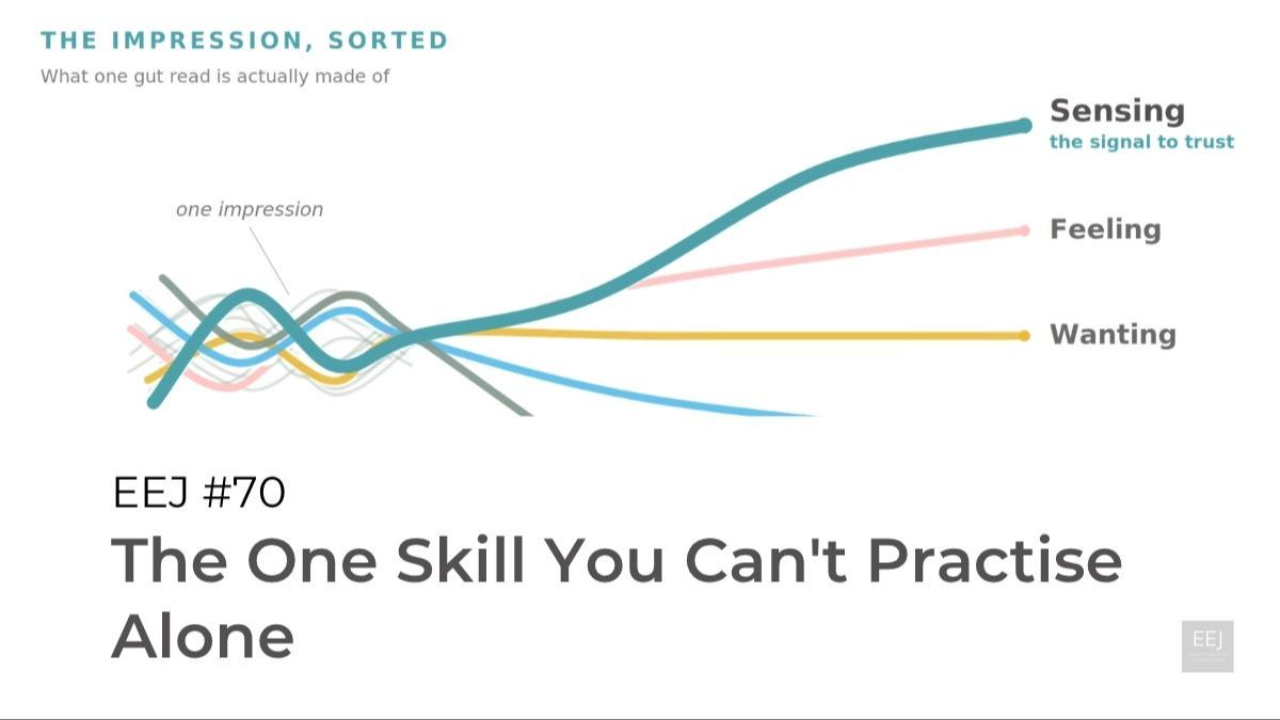
The One Skill You Can't Practise Alone
Issue #70
The next level of reading is knowing which of your reads to trust. Here is how it develops, and the one part you cannot train alone.
Welcome to The Executive Energy Journal, written for professionals who choose to lead with purposeful clarity. A grounded, science-informed take on managing subtle energy, spanning from neuroscience to spiritual connection.
How EEJ works
- What's measurable: what research and observable mechanisms support
- What's unknown: where evidence ends, and interpretation begins
- What I do pragmatically anyway: the simplest reliable practice I use with clients
- Your role: take what is useful and leave the rest
1. You read it before anyone spoke
You knew the meeting had turned before a word confirmed it, because your body registered it before your mind had language for it.
That is not a party trick. It is a real capability, built over years, and it is most of why people want you in the room.
So this issue is about the next level of that skill, the one most perceptive people never train, because no one told them it was trainable.
The next level is not "more sensitivity", trying to read "more". You have plenty already, and perceiving or sensing more would only mean more noise. The upgrade is discernment: the ability to tell, in the moment, which of your reads is solid signal and which is a story you have layered on top of it, and which of the two you can act on. Reading is picking up the data. Discernment is knowing what the data is worth.
Most people stall at the first and call it intuition, and accept the hit-and-miss framework that comes with it. The ones worth trusting have built the second.
2. How the second skill gets built
Here is a clue to how, from an unexpected place.
This year, Anthropic researchers tested whether AI systems could observe their own internal states. The result was mixed in a telling way. The models could sometimes do it, noticing and naming what was happening inside them, but only partially and unreliably, and when they couldn't, they filled the gap with confident, invented accounts. The only way to tell the real self-reports from the made-up ones was to check them against a known outside reference.
That is the pattern we can and should borrow. A system reading itself gets some of it right, and cannot, on its own, tell which part. An outside reference is what sorts the accurate read from the confident story. You are no different, and the research on people says so with some precision.
In research terms: you are the most accurate judge alive of your own internal weather, your mood, your unease, the texture of what you feel. Keep trusting that; nothing outperforms you there.
But on the read that matters most in a room, an outside vantage is reliably more accurate: how you are landing, whether the pattern you sense is really there. There is one plain reason for it. Another person can see your behaviour, and you cannot. This is the shape of the instrument, not a defect to fix, and it points straight at how the upgrade is built.
You develop discernment by pairing your inside read with an outside reference, again and again, until you can feel the difference on your own.
Let's take a short pause here and notice something: When you slow down enough, you can already sense the gap between a fact in your body and a conclusion in your head.
3. A decision that wouldn't close
A founder I worked with was weighing whether to sell the company she had built. On paper it was a clean question of pros and cons. In her body it would not resolve, because it kept getting tangled with a home life she loved. Two small children, days that were full in a way she also loved. She could not tell where one pull ended and the other began.
There was one detail she kept waving off. For about a year, most days, she had caught herself thinking, or saying out loud, I need a proper holiday. She treated it as a throwaway line, just a part of her everyday. ("Doesn't everyone need a proper holiday?")
Energetically, it was actually the most important read she had, and she could not see it, because she had said it so often it had stopped sounding like information and started sounding like weather.
We did not sit down and pull an intuitive answer out of the air, and I definitely did not hand her one. That is not where clean decisions come from, or how.
Instead we built three things.
- First, a way to settle her state in the five spare minutes she could find, because a read taken from a frayed system is mostly noise.
- Then, the skill of telling apart what she was feeling, what she was sensing, what she wanted, and what she was afraid of: four different signals she had been reading as one.
- And last, the right questions, coming from her own system, the ones that let her line the decision up against what she needed, what her family needed, and what the company needed, without the second-guessing quietly draining her.
The holiday sentence turned out to be worth decoding. Whether it meant I am exhausted or I am ready to be done, or something else entirely is not mine to tell you. It was hers to find, and she found it.
4. What the upgraded read feels like
That is what the skill does as it develops, and not only for a founder considering an exit.
You still feel the doubt. What changes is that you know which signals to stand on, so you stop re-evaluating the rest. A read comes. You feel it clearly, you hold it lightly, you check it against something steadier than your own mood, and you move. Cleaner, faster, with far less private churn afterward.
The evening stops being a private debate arena. You are precise about the few things that carry weight, and easy about the rest. That is what trained perception looks and feels like from the inside: quieter, more peaceful even, and more exact.
5. The first rep
The training starts small, and you can begin today.
When a read is running, split it into two lines before you trust any of it. First, only the sensation: my chest tightened when she went quiet. The physical fact. No meaning. Then, separately, the story: she is angry with me.
Trust the first line. It is data. Hold the second as one candidate among several. That single split is the entry-level rep of discernment: you are teaching your system to feel the seam between signal and story. Do it for a week, and the seam starts to show up on its own.
6. Where solo reps reach their ceiling
You can take that practice a long way alone. But every trainable skill hits the point where you cannot be both the performer and the mirror at once, the point where you need an outside reference to see your own form.
For self-reading, that point is the pattern: the specific story you reach for again and again, so often that it no longer feels like a read at all. The founder could not hear her own holiday sentence for a year. It was hers, and it had become weather, and that is what made it invisible.
Your version may be louder or quieter, and just as invisible from the inside. It's for the same reason a singer cannot fully hear their own voice in the room they are standing in. Every system that reads itself runs into this, and it is why reference points exist.
Take what is useful here and leave the rest. The two-line practice is yours to keep either way. But the pattern is the part that needs a reference outside your own head, and that is not a gap in the skill. It is simply the next rep.
If a read keeps running after you'd like to move on already, and you cannot tell from the inside whether you are seeing clearly or just seeing it loudly, nothing is wrong with your perception. You have reached the point where the next level of the skill needs an outside reference: the one part you cannot train alone.
The two-minute read on the site shows you which pattern your system defaults to, from the outside, where it finally becomes visible and trainable.
One scheduling note: through July and August, the Journal arrives every other Sunday. The next issue comes two Sundays from today.
Until then,
Niina
by Niina Gullstén July 5, 2026
References
- Nisbett, R. E., & Wilson, T. D. (1977). Telling more than we can know: Verbal reports on mental processes. Psychological Review, 84(3), 231–259.
- Vazire, S. (2010). Who knows what about a person? The self–other knowledge asymmetry (SOKA) model. Journal of Personality and Social Psychology, 98(2), 281–300.
- Morales, J. (2024). Introspection is signal detection. British Journal for the Philosophy of Science, 75(1), 99–126.
- Lindsey, J. (2025). Emergent introspective awareness in large language models. Anthropic.