
How to Untangle a Decision That Keeps Circling
Jun 19, 2026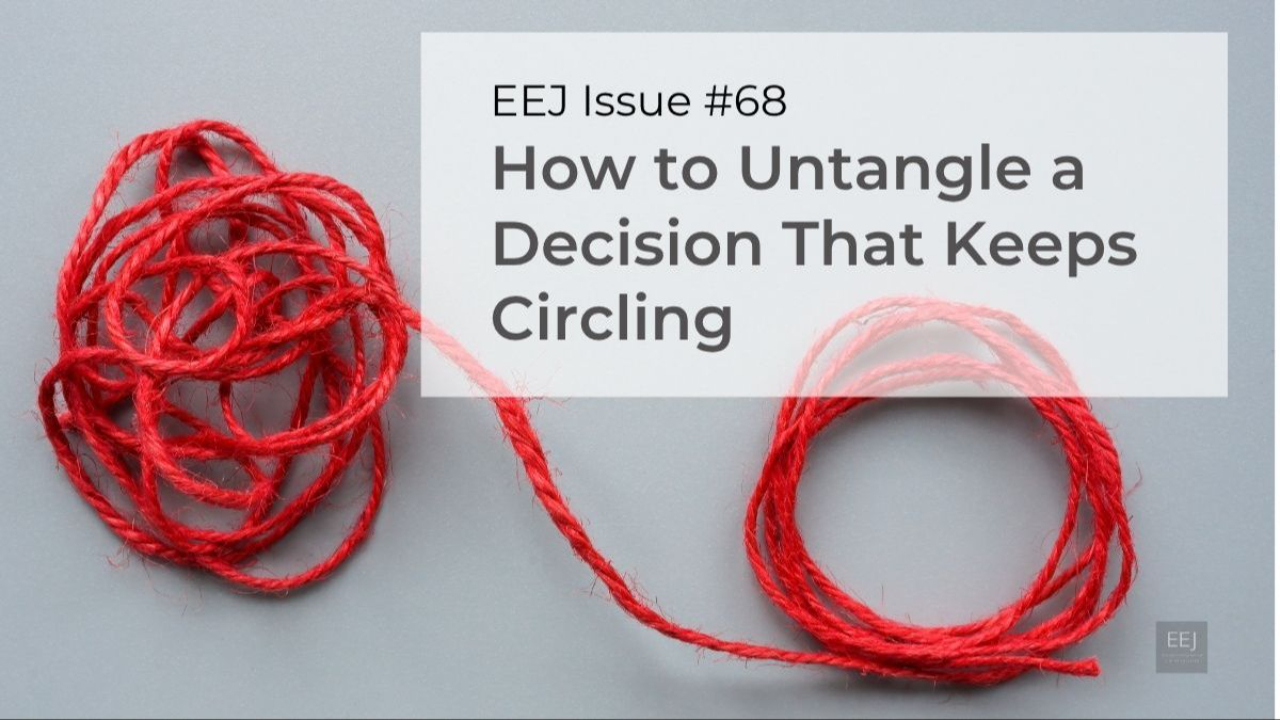
How to Untangle a Decision That Keeps Circling
Why the situation that keeps circling is rarely short on thinking
Executive Energy Journal — Issue #68
Welcome to The Executive Energy Journal, written for professionals who choose to lead with purposeful clarity. A grounded, science-informed take on managing subtle energy, spanning from neuroscience to spiritual connection.
How EEJ works
What's measurable:
- what research and observable mechanisms support
- What's unknown: where evidence ends, and interpretation begins
- What I do pragmatically anyway: the simplest reliable practice I use with clients
- Your role: take what is useful and leave the rest
There is a situation you keep coming back to, like a decision that will not close, or a conversation that replays at odd hours. Or maybe a read on a person you cannot quite separate from your own worry.
You have already thought it through. You have talked it over, slept on it, even written it down. By now you may also be tracking the rest of your life: the sleep score, the stress graph, the focus minutes. And the culture around you has one instruction for a situation that will not settle: You need to look closer, measure more, and optimise.
So you run the loop again. And the situation stays exactly as loud as it was.
1. The loop that feels like work
Here is the part that makes this so hard to stop.
The circling feels productive. Reviews of repetitive self-focused thinking find that it impairs problem-solving, interferes with taking action, and keeps negative thinking alive, all while feeling like diligence from the inside (Nolen-Hoeksema, Wisco & Lyubomirsky, 2008). Your system reads the effort as progress, so it keeps spending it.
There is a useful split inside this. Researchers separate brooding, a passive turning-over of the same material against some standard it never meets, from reflective pondering, a purposeful turn inward toward an actual next step (Treynor, Gonzalez & Nolen-Hoeksema, 2003). They can feel almost identical while you are inside them, but only one produces movement. The other produces more of itself.
A perceptive professional is especially good at fuelling the loop, because there is always more to notice. More nuance, more angle, more of what other people might be feeling. The capacity that makes you good at the work is the same capacity that keeps the situation spinning.
2. More data is not the missing piece
The wider culture has been selling the opposite read for a decade. Measure it and you will master it.
The evidence is more honest than the marketing. A recent meta-analysis of self-quantification found a real positive effect on wellbeing alongside a quieter cost, running through body image and self-esteem, that eats back into the gain (Jain et al., 2025).
Measurement is not the villain. It simply cannot do the one thing the loud situation actually needs, which is sorting. A dashboard can tell you your heart rate climbed in the meeting. It cannot tell you whether what climbed was your signal or something in the room that you reacted to.
This is why the current turn away from constant self-optimisation is more than a mood. People are reaching the end of what another metric can give them and beginning to ask a different question: not how to measure the state, but how to read it cleanly.
Pause here. Notice your jaw, your shoulders. One slow breath before the next line.
3. Sensing is not the same as sorting
Your body is already doing the part the dashboards cannot.
The internal sense, what researchers call interoception, is real and now well mapped. The work that grounds the field shows it is not one ability but three that come apart:
- how accurately you actually register an internal signal
- how strongly you feel that you do
- whether your confidence tracks your real accuracy (Garfinkel, Seth, Barrett, Suzuki & Critchley, 2015).
These dimensions often do not line up. A signal can arrive loud and certain and still be telling you very little real information.
That gap is the whole problem in one line. The body registers. The sorting of what the registration means is a separate operation, and it is the one that goes wrong.
In practical terms: you walk out of a meeting carrying something. The carrying is accurate data that something happened. What it is, whose it is, and whether it asks anything of you are three further questions, and the loop keeps treating them as one.
4. Where the evidence stops
The research maps the channel inside the body well. Where it thins out is exactly where most of your harder situations occur: the relational layer. The weight you picked up from someone else and are now carrying as if it were your own. There is no clean instrument yet for that handoff, no researched task that tells you which part of what you feel originated in you and which crossed over from the person across the table.
That layer is not mystical, even though it may seem so. It is information, exchanged faster than speech. It is simply the part the measurable account cannot reach yet. So you are left to sort it by feel, while inside the loop that generates the noise, with the same system that is doing the holding. That is genuinely difficult, and it is not a personal failing that it is.
5. What I do instead
I stop trying to think the situation into resolution. I sort it.
In practice that means separating a few things that arrived fused. What in this is actual signal (useful information), and what is residue left over from the people around it. What is mine to carry, and what I absorbed and am holding by habit. What is asking for a decision, and what can simply be set down.
There is a simple method to this. You take what is looping and lay each piece into one of four specific buckets, so the strands come apart instead of staying fused. This week's Friday Debrief walked through the exact steps. The point here is only that the move is sorting. The thinking has already been done.
Most of the load in a stuck situation is in the fusion, not the content. Once the strands come apart, the decision underneath is often small, and it was never the thing keeping you up. The volume drops because the system stops guarding a tangle it could not name.
You do not need more information to do this. You have been gathering information for weeks. You need the tangle pulled apart, including the parts that do not yet have a tidy explanation.
Notice whether anything in you just relaxed at the words "set down." That response is data.
6. When it's one specific situation
Some things settle on their own once you see them this way. The loop resolves, the strand comes loose, and you move on.
But when a single situation keeps returning, like a read on someone you cannot separate from your own worry, that is usually a sign it is structural rather than situational. More thinking will keep running the same loop, because the part doing the thinking is the same part generating the noise.
That is what the 15-minute call is for. We take the one situation and find where it is tangled, so you leave knowing what is signal, what is yours, and what the cleaner next step is. If it turns out the situation is deeper than fifteen minutes can hold, that is what a Private Reset & Clarity Session is for, where we sort it fully, including the parts that do not yet have a tidy explanation. I take those seriously and work with them precisely.
Until next Sunday,
Niina
by Niina Gullstén, June 19, 2026
References
- Garfinkel, S. N., Seth, A. K., Barrett, A. B., Suzuki, K., & Critchley, H. D. (2015). Knowing your own heart: Distinguishing interoceptive accuracy from interoceptive awareness. Biological Psychology, 104, 65–74.
- Jain, et al. (2025). Self-quantification and consumer well-being: A meta-analytic review. Psychology & Marketing.
- Nolen-Hoeksema, S., Wisco, B. E., & Lyubomirsky, S. (2008). Rethinking rumination. Perspectives on Psychological Science, 3(5), 400–424.
- Treynor, W., Gonzalez, R., & Nolen-Hoeksema, S. (2003). Rumination reconsidered: A psychometric analysis. Cognitive Therapy and Research, 27(3), 247–259.