
You Don't Have to Resolve It to Stop Replaying It
Aug 02, 2026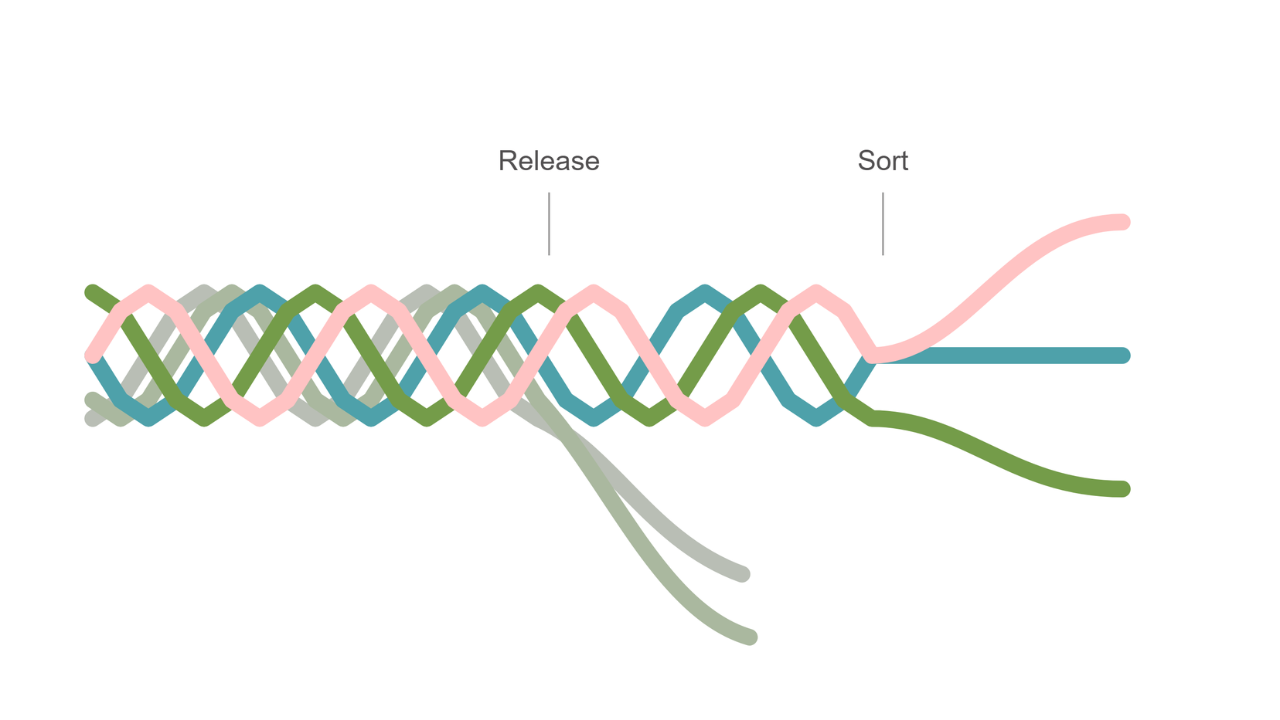
You Don't Have to Resolve It to Stop Replaying It
Why a finished conversation keeps running, and why the version you are holding gets colder every night.
Niina Gullstén | Executive Energy Journal | Issue #72
Welcome to The Executive Energy Journal, where we explore a side of leadership few talk about—the subtle energy we have, live in, and how it impacts clarity, decision-making, and performance.
How EEJ works
- What's measurable: what research and observable mechanisms support
- What's unknown: where evidence ends, and interpretation begins
- What I do pragmatically anyway: the simplest reliable practice I use with clients
- Your role: take what is useful and leave the rest
In this issue:
- What closes a conversation that will not close, and in what order
- What thirty years of research says is happening to your record of interaction (not to your memory of it)
- Why a read can be entirely real and still not be about the meeting you are replaying
Introduction
It is eleven at night and you are back in a meeting that ended at four.
Not the whole meeting, just ninety seconds of it. The pause before person X answered, the way the second question was phrased. The thing you said, which you have now heard back a dozen times in your own voice.
You are not imagining things and you are not overthinking. Something in that room registered, and your system has not been able to file it. That is an energy leak with a particular shape: it does not drain you during the meeting, it drains you for the four nights afterwards. And on Thursday you will sit down with X again, working from a version of that meeting that has actually changed in the meantime.
1. What really closes the file
You have been assuming this ends when you work out what X meant, or when you get to say your side, or when someone who was there confirms you were not imagining it.
That is exactly why it does not end: all three depend on someone else.
Most of what a meeting leaves behind energetically does not need resolving or understanding. It can simply be put down. Atmosphere, someone else's tension, the tail end of a difficult exchange. All that is residue, and a deliberate release handles it in a couple of minutes without any analysis at all. If you have never tried putting one of these down on purpose, try that before you try anything else. It works more often than people expect.
This issue is about the exception. The one that comes back after you have released it, and comes back again the next night.
That one does not need resolving either. It needs sorting. What arrives from a conversation arrives braided, like several separate threads registered as one impression. Your own reaction is in there, and so is what you picked up from someone else. Also, what you were hoping for or bracing against, and at least one thing that is not about this meeting at all.
Separating them may sound like an exercise in self-knowledge, but in reality it is how you find out what is actually relevant. The part that is real, current, and yours to act on. Separating it all is how you establish everything that can be put down. Most of what is in the braid can. But you cannot put any of it down with confidence while it is all still one lump, which is why the whole thing stays on the desk in the first place.
And it can be done on your own, in the dark, tonight, without speaking to anyone who was in the meeting.
Three things make the difference, and the order is more important than any of them individually.
Settle before you ask. Do not run a precise question from inside the replay. Use the Quick preview audio sequence available on my site. You are not calming down as a courtesy to anyone, you are changing which processing mode is running before you ask anything, and you are moving attention off yourself, which is the part that stops the replay feeding itself.
Start with the oldest thread. Of everything in the braid, the one worth pulling first is the part that is not about this meeting at all, because until it is out, every other thread you examine is coloured by it. Ask what the feeling might be remembering before you ask what it means.
Do it the same night. Your memory of an interaction is at its most accurate immediately and degrades from there, selectively and in one direction. Section 2 explains what is being lost. For now: whatever sorting you do, do it while the record is still intact.
I'm going to present an example of the sorting, because it is the one that sounds impossible until you have done it once.
Intuitive signals tend to arrive through the same channels each time; the same place in the body, the same quality, the same volume. Fear usually has its own address, higher and tighter, often close to the diaphragm. Telling one from the other is a skill rather than a talent, and most people have never been told that.
A client of mine was certain her instinct was telling her not to present to her board. It was steady, it was physical, and she had every reason to take it seriously—she is a perceptive woman and her reads are usually good. Tracked properly, it turned out to be her body recalling a humiliation from school. She named the memory. The feeling went. She presented, and did well.
Her perception had not failed her. A thirty-year-old file had simply been sitting in the same drawer as the live one, and everything in the drawer felt equally current.
A read becomes exact when it has been tested against an outside reference. Testing means separating what you observed from what you concluded, and the two arrive fused. Friday's Debrief has the steps for the first separation, and they are yours to keep.
2. What the research shows
What you do at eleven at night has a formal name and thirty years of study behind it. It is called post-event processing, first described by Clark and Wells in 1995, and defined as the repeated consideration and potential reconstruction of your own performance after a social situation (Brozovich & Heimberg, 2008).
Note reconstruction. Even the research concedes that the replay is not a recording.
Two findings here.
- Social exposure in ordinary working life often does not follow the rule of graded exposure (Do the thing repeatedly and the fear reduces.) Post-event processing appears to be part of why (Flynn & Yoon, 2024). You may have run four thousand meetings and it has not made this easier. That is not a failure of nerve or of practice. What happens in the hours afterwards undoes what the meeting itself would otherwise have taught your system.
- The second is why I ask clients to close the same night. People gave an unexpected presentation and received standardised feedback, so there was a known truth to measure against. They rated their memory of that feedback after five minutes, and again a week later. Immediately afterwards, recall was accurate. Over the following week, the recalled warmth of the positive feedback faded. Memory for neutral feedback did not move at all (Glazier & Alden, 2017).
So the replay does distort the record. But look at how.
It does not invent. It doesn't manufacture a hostile remark that was not made. But it subtracts. The reassurance that was actually offered loses weight, night after night, while everything sharper stays where it was.
And it subtracts one thing in particular. What loses weight is the warmth, not the content. Which means the file degrading on your desk is not your record of the meeting. It is your record of how the person regarded you.
The picture you are holding at eleven o'clock is likely to be false, yet every single element in it genuinely happened.
This is why you cannot catch it by thinking harder. You can interrogate your memory honestly for exaggeration, find none, and pass your own test, because the error is not an addition. This is also why am I overthinking this? is the wrong question. That question tests for invention.
3. What the research cannot tell you yet
Three conclusions, then where they come from.
A) Your read was not distorted going in. Every study above was run on socially anxious or clinically diagnosed people. The machinery they describe is real. The assumption underneath it—that the perception was faulty from the start—is not yours and does not transfer.
B) The read is partial, not wrong. Strong on the negative channel, thin on the neutral and the positive one. Which is a sorting problem, and it is why both of the usual instructions fail you. Trust your gut hands you a partial picture. Stop overthinking throws out the accurate part along with the rest.
C) And the mental / energetic state you sort in is not the state you perform in. Two different jobs. They do not want the same conditions, and you are not obliged to run one of them all week.
Here's the background
On B: in 2020, two studies reached opposite conclusions. One found greater accuracy at reading others' emotions in socially anxious people and in diagnosed patients alike (Auyeung & Alden, 2020). The other found the association ran the other way, on theory-of-mind and empathic accuracy tasks (Alvi et al., 2020). A meta-analysis lands somewhere more precise and considerably more useful: a small positive association with affective empathy, a small negative one with the cognitive, inferential kind (Pittelkow et al., 2021).
C is the one that should change what you do tonight, and it needs an old idea cleared out of the way first.
There is a long-standing belief that the low mood is the accurate one. Seligman gave it its most careful treatment in Learned Optimism: pessimism's single virtue, he wrote, is a keener sense of reality, and yet optimists outperform pessimists in the field, which is why he argued for flexible optimism rather than either setting permanently. An organisation needs its pessimists, he said, the people holding an accurate picture of present conditions. It also needs people who will try things.
The accuracy half of that has weakened considerably since. A meta-analysis of seventy-five studies found the effect real but very small, and smaller again in the studies that measured against an objective standard (Moore & Fresco, 2012). A well-powered pre-registered replication found nothing (Dev et al., 2022).
So do not defend the replay on the grounds that it is at least accurate. That defence has largely not survived.
What has survived is narrower and more useful to you. A negative state genuinely does protect against false memory and holds item-level detail, where a positive state loosens both (Storbeck & Clore, 2005). But perseverating negative mood impairs detection specifically about people, and predicts mistaking what belongs to someone else for your own. Those who can down-regulate the negative mood show no such impairment (Baumann & Kuhl, 2002; and see EEJ issue #5 on mood and intuitive judgement, Bolte, Goschke & Kuhl, 2003).
Which gives you the whole picture. The replay state holds the detail and loses the actual meaning. The bright state reads the meaning and goes soft on the record. Neither one is the sorting state.
The settle I use aims at a third position: out of the perseveration without going anywhere in particular. Grounded, close to neutral, attention slightly off yourself. This last part is important, since self-focused attention and negative affect feed each other in a loop (Mor & Winquist, 2002).
And Seligman's division holds at the scale of your week. Sort at eleven at night, vs. walk in on Thursday in something else entirely. You are simply choosing which mode of operating is suitable for which job.
To my knowledge nobody has tested that account against the social anxiety empathy literature. I am putting it on the record as a claim, not as a finding. It is why the settle comes first in everything I teach, and the research has not yet caught up to it.
4. Where the cost lands
It does not stay in your head.
Let's say you sit down with X again working from a composite that silently lost its warmth over four nights. You read X slightly cooler than the reality is. X registers that and adjusts. Neither of you names it, and a working relationship drifts on the basis of a record that eroded rather than an event that happened.
This is a judgement error about a person you have to keep working with, made on evidence you would have rejected if you could have watched it degrading.
Your team registers it too. Not the content—they cannot know what happened in that meeting—but the fact that some portion of you is allocated elsewhere. A leader carrying an open file is less available, and unavailability always gets interpreted. For example as displeasure, and by the person least responsible for it.
5. The takeaway
Most of the weight in a replaying conversation is not in the content. It is in the braiding: several separate threads arriving at once and filing themselves as one item, only one of which is usually the thing that needs anything from you. Pulled apart, what genuinely requires action is smaller than the lump suggested, and everything else can go.
The conversation closes the night it happens instead of four nights later. You go to bed still holding the read—you have not thrown it out, you have sorted it—without the ninety seconds attached. The evening stops being a review hearing. And in the next conversation with X, you walk in with the record intact.
The conversation does not need to resolved. The impression needs to be sorted.
6. Where to Take It
Take what is useful here and leave the rest. Friday's test is yours to keep either way. The oldest thread is one of several in the braid, and often the loudest, which is why pulling it out may already make a big difference.
What that test will not do is separate the rest of them, or tell you which one is the one that matters. The full sort is a sequence, and a sequence takes a little teaching.
If this is a general pattern for you, keep running Friday's test and it will keep paying.
If it is not a pattern but one specific conversation you are carrying right now—the one you would name if I asked you to name it—that is what Stop the replay is for. The settle, then the sort that separates the threads, then the questions that tell you which part is real, current and yours to act on, and which part you can set down tonight. Self-guided, about two minutes once you know it, and it does not need me in the room.
And if it is not one conversation. If most meetings leave something behind, sorting each one individually is the slow road. That is what the Meeting reset is for—the release without analysis described at the top of this issue, plus the part that matters more over a working week: entering the next meeting in a state where less of it sticks to you in the first place.
Until Sunday in two weeks,
Niina
References
- Alvi, T., Kouros, C. D., Lee, J., Fulford, D., & Tabak, B. A. (2020). Social anxiety is negatively associated with theory of mind and empathic accuracy. Journal of Abnormal Psychology, 129(1), 108–113.
- Auyeung, K., & Alden, L. E. (2020). Accurate empathy, social rejection, and social anxiety disorder. Clinical Psychological Science, 8(2), 266–279.
- Baumann, N., & Kuhl, J. (2002). Intuition, affect, and personality: Unconscious coherence judgments and self-regulation of negative affect. Journal of Personality and Social Psychology, 83(5), 1213–1223.
- Bolte, A., Goschke, T., & Kuhl, J. (2003). Emotion and intuition: Effects of positive and negative mood on implicit judgments of semantic coherence. Psychological Science, 14(5), 416–421.
- Brozovich, F., & Heimberg, R. G. (2008). An analysis of post-event processing in social anxiety disorder. Clinical Psychology Review, 28(6), 891–903.
- Clark, D. M., & Wells, A. (1995). A cognitive model of social phobia. In R. G. Heimberg, M. R. Liebowitz, D. A. Hope, & F. R. Schneier (Eds.), Social phobia: Diagnosis, assessment and treatment (pp. 69–93). Guilford Press.
- Dev, A. S., Moore, D. A., Johnson, S. L., & Garrett, K. T. (2022). Sadder ≠ wiser: Depressive realism is not robust to replication. Collabra: Psychology, 8(1), 38529.
- Flynn, A. J., & Yoon, K. L. (2024). Post-event processing in social anxiety: A scoping review. Clinical Psychology Review.
- Glazier, B. L., & Alden, L. E. (2017). Social anxiety and biased recall of positive information: It's not the content, it's the valence. Behaviour Research and Therapy.
- Moore, M. T., & Fresco, D. M. (2012). Depressive realism: A meta-analytic review. Clinical Psychology Review, 32(6), 496–509.
- Mor, N., & Winquist, J. (2002). Self-focused attention and negative affect: A meta-analysis. Psychological Bulletin, 128(4), 638–662.
- Pittelkow, M.-M., aan het Rot, M., Seidel, L. J., Feyel, N., & Roest, A. M. (2021). Social anxiety and empathy: A systematic review and meta-analysis. Clinical Psychology Review.
- Storbeck, J., & Clore, G. L. (2005). With sadness comes accuracy; with happiness, false memory: Mood and the false memory effect. Psychological Science, 16(10), 785–791.
Also: Seligman, M. E. P. (1990). Learned Optimism: How to Change Your Mind and Your Life. Alfred A. Knopf.