
The Work You're Doing That Nobody Knows About - Part 1/2
Oct 18, 2026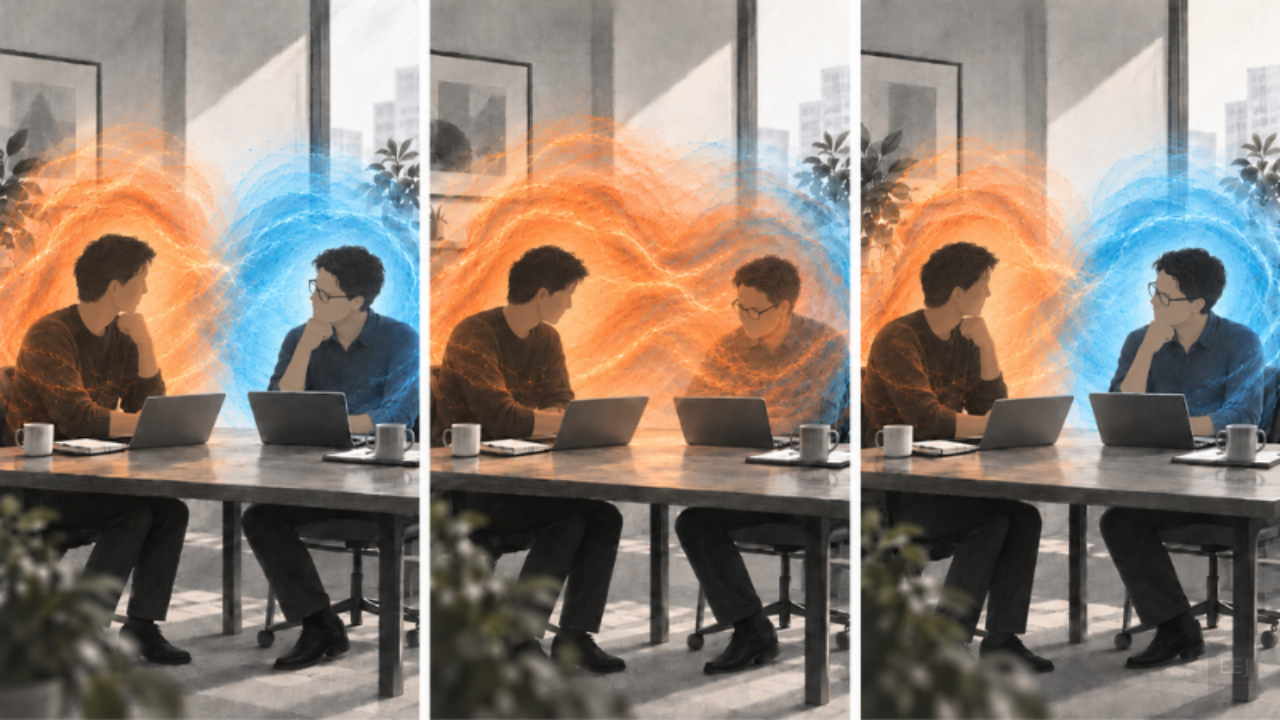
The Work You're Doing That Nobody Knows About - Part 1/2
How other people's energy can become something you carry
Welcome to The Executive Energy Journal, where we explore a side of leadership few talk about: the subtle energy we have, live in, and how it impacts clarity, decision-making, and performance.
How EEJ works
- What's measurable: what research and observable mechanisms support
- What's unknown: where evidence ends, and interpretation begins
- What I do pragmatically anyway: the simplest reliable practice I use with clients
- Your role: take what is useful and leave the rest
In this issue
There are times when you leave a meeting, a conversation or even a particular place and notice that something has changed in you. You may feel unusually unsettled, tired or "heavy". Perhaps you find yourself thinking about a problem that was never yours to solve, or feeling concerned about someone whose situation has little to do with your own.
Sometimes the change is obvious. At other times, you only become aware of it later, when you realise that your own state has shifted and you cannot immediately explain why.
We affect one another in many ways, and some people seem particularly aware of what is happening beneath the visible interaction. That awareness can be valuable. It can also become the beginning of work that nobody knows you are doing, particularly when something you have perceived stays with you and even becomes something you feel responsible for.
This is the first of two Executive Energy Journal issues exploring that invisible work. I'm starting with what happens within and between people, including the energetic interactions I perceive.
In Part Two, I'll look more closely at the responsibilities people inadvertently assume, and how organisations, relationships and entire systems can come to depend on work that is rarely recognised.
1. What are you actually taking in?
In my work, I perceive energy and energetic interactions. I use the word energy deliberately, because it describes my experience more accurately than the available psychological terminology.
I perceive energetic fields associated with people, groups and environments. They can have different qualities, such as density, movement, coherence and boundaries. There may be areas of tension, disturbances or patterns of interaction. Sometimes the information I perceive relates to someone's emotional state. At other times, it concerns something less easily described, such as an underlying relational pattern or an unresolved situation.
For me, energy is also information. That does not mean every impression arrives with a clear explanation. Perceiving something and understanding what it means are different stages of inquiry, and I consider it important to keep them separate.
The information is not necessarily negative or uncomfortable. An interaction can be energising, reassuring or clarifying. There are people and environments that seem to support greater coherence and ease, just as there are others that can leave someone feeling disturbed or depleted.
I have been experimenting with ways of making these interactions visible. The following is an AI-assisted illustration of one aspect of what I perceive.
What happens when you first absorb someone else's emotions and then return to your own baseline state?

The distinction I want to draw attention to is what happens when someone encounters another person's emotional state. They may perceive it while remaining reasonably centred within their own space. Or they can become affected by the other person's state temporarily, or even continue carrying something from the interaction afterwards.
And what stays may influence what they notice, how they interpret subsequent situations and what they feel they should do.
2. What does research tell us?
There is considerable scientific interest in how people's emotional states influence one another. The research approaches the question differently from my energetic observations, but it provides evidence that interpersonal influence is not limited to conscious communication or decision-making.
In a 2014 experiment, researchers investigated whether observing another person under stress could produce a measurable physiological stress response in the observer. Of the 211 observers, 26% showed a significant increase in cortisol. The effect was more common when the person being observed was a romantic partner, but it also occurred between strangers and when the stressful situation was watched through a video connection.
The researchers described this as empathic stress. Their findings demonstrate that another person's experience can influence an observer's physiological state, even when the observer is not directly exposed to the stressful event.
I don't claim this would establish the energetic mechanism I describe. It does, however, show that
interpersonal influence can extend beyond what people consciously decide to feel or do.
Another perspective comes from Emotions as Social Information model. This work distinguishes between two ways another person's emotions can influence us. We may experience an affective response, meaning that our own emotional state changes, or we may interpret the person's emotional expression as information about the situation.
So, recognising someone else's anxiety, for example, does not necessarily mean becoming anxious yourself. You might simply recognise that the person is concerned about something and use that information to understand the interaction.
Equally, you might find yourself affected before you have consciously identified what is happening.
Research has also shown that people do not always interpret emotional information accurately. Context, expectations and previous experience can influence what someone believes another person's emotional expression means.
A real impression does not guarantee a correct explanation of its source.
This is one reason I place considerable importance on becoming centred before interpreting energetic information. In my experience, when my own reactions have settled, it becomes easier to distinguish what I am perceiving from what I may be adding to the interpretation.
That is my practitioner observation, rather than a conclusion established by these studies.
3. The energy of groups and places
Interpersonal interactions are only one part of the picture.
Most people are familiar with the experience of entering a room and becoming aware of its atmosphere. A meeting may feel tense before any disagreement becomes visible. A group may feel unusually unsettled, even though no individual appears particularly anxious.
In organisational research, collective emotional dynamics are recognised. A 2002 study of emotional contagion in groups demonstrated that the mood expressed by one group member could influence the moods, attitudes and interactions of other members during a decision-making exercise.
The findings show how emotional influence can become a group-level phenomenon. What is happening within a group may affect its functioning, even when nobody explicitly discusses the emotional dynamics involved.
My own perception extends beyond these observable interactions. I also perceive energetic qualities in collectives and in places themselves, sometimes when the people associated with them are no longer present.
In addition, environmental psychology suggests that the design of indoor environments can influence emotional responses.
Those findings do not prove that places retain subtle energy independently of their physical characteristics or the people who occupy them. That aspect remains within my own perception and investigation.
What matters for this discussion is that people can experience themselves as being affected by something beyond the immediate exchange of words or actions. And sometimes, the effects stay.
4. When something stays
I find it useful to distinguish three processes
- perceiving energetic information
- becoming affected by it
- allowing it to remain within one's own experience.
These processes can happen very quickly, and a person may have little conscious awareness of them.
Imagine noticing that a colleague is anxious about an important decision. You recognise the anxiety, perhaps even experience some of it yourself, and continue with your day. If the interaction is complete and you remain centred, that may be it.
But suppose the anxiety stays with you. You suddenly find yourself anxious without knowing why. And because people tend to look for reasons for their emotions, you may start finding things to be anxious about, even though the anxiety you initially absorbed was not yours. Those explanations can then reinforce the anxiety, making it stronger.
You may not consciously decide to take on any of this. The progression can be gradual enough that you only notice the additional burden once it has become familiar.
There are also psychological processes that could produce similar experiences, including emotional contagion, anticipation, rumination and concern for another person. These possible explanations do not prove or eliminate the others.
The useful distinction here is what you do with what stays with you.
You may find a way to detach from the external emotion and return to your own baseline state. You may continue carrying it without feeling any obligation to act. You may choose to help because you genuinely want to. Or you may begin to experience the situation as something that somehow belongs to you.
That last possibility is where invisible responsibility begins.
5. How information becomes responsibility
Consider the same colleague. You know they are anxious, and you can see that their anxiety might affect the decision-making process.
You begin to monitor how they are doing. You anticipate what might make the situation worse. During meetings, you adjust your communication to avoid increasing the tension. Perhaps you start compensating for difficulties that might otherwise become visible.
Some of these responses may be appropriate and helpful. They may also reflect real responsibilities within your professional role.
But the point to watch out for is when responsibility follows simply because you have become aware of something.
Being able to perceive a problem may make you particularly capable of responding to it. That does not automatically mean that the problem is yours to manage.
The same progression can occur in families, teams and communities. Someone notices an uncomfortable dynamic, becomes affected by it and gradually takes responsibility for maintaining stability. Over time, the effort may become so habitual that neither the person performing it nor the people benefiting from it recognise how much work is involved.
An interesting parallel comes from research on empathy and compassion. In a 2014 study, training people in empathic resonance increased negative affect when they observed others suffering. Subsequent compassion training reduced that negative affect while increasing positive affect.
The study does not address energetic absorption, but it illustrates an important possibility:
remaining responsive to another person's difficulty need not require continually sharing their distress.
From my perspective, something similar is relevant to energetic boundaries. A person can remain aware, connected and responsive without retaining (absorbing) everything they encounter.
Even when something has been retained, there is still an opportunity to recognise it, release what does not belong, and consciously decide whether involvement is necessary.
Coming next: What You Take On
Something that begins as perception can gradually become a responsibility, and eventually work that nobody else even knows you are doing.
In the next issue, I'll look more closely at that invisible work: the anticipating, monitoring, compensating and quietly repairing that keeps situations functioning, often without anyone recognising the effort involved. I'll also explore an interesting possibility: that someone's ability to keep things functioning can actually prevent the underlying problems from becoming visible.
For now, I'd be interested in your experience of the energetic visualisation. Does it help make something recognisable? Is there anything that confuses or clarifies? Please share your thoughts, either in LinkedIn DMs or email ([email protected]).
Until next time,
Niina
References
- Barsade, S. G. (2002). The ripple effect: Emotional contagion and its influence on group behavior. Administrative Science Quarterly, 47(4), 644–675. https://doi.org/10.2307/3094912
- Bower, I., Tucker, R., & Enticott, P. G. (2019). Impact of built environment design on emotion measured via neurophysiological correlates and subjective indicators: A systematic review. Journal of Environmental Psychology, 66, 101344. https://doi.org/10.1016/j.jenvp.2019.101344
- Engert, V., Plessow, F., Miller, R., Kirschbaum, C., & Singer, T. (2014). Cortisol increase in empathic stress is modulated by emotional closeness and observation modality. Psychoneuroendocrinology, 45, 192–201. https://doi.org/10.1016/j.psyneuen.2014.04.005
- Klimecki, O. M., Leiberg, S., Ricard, M., & Singer, T. (2014). Differential pattern of functional brain plasticity after compassion and empathy training. Social Cognitive and Affective Neuroscience, 9(6), 873–879. https://doi.org/10.1093/scan/nst060
- Van Kleef, G. A. (2009). How emotions regulate social life: The Emotions as Social Information (EASI) model. Current Directions in Psychological Science, 18(3), 184–188. https://doi.org/10.1111/j.1467-8721.2009.01633.x