
Calm Is Not the Same as Grounded
Aug 16, 2026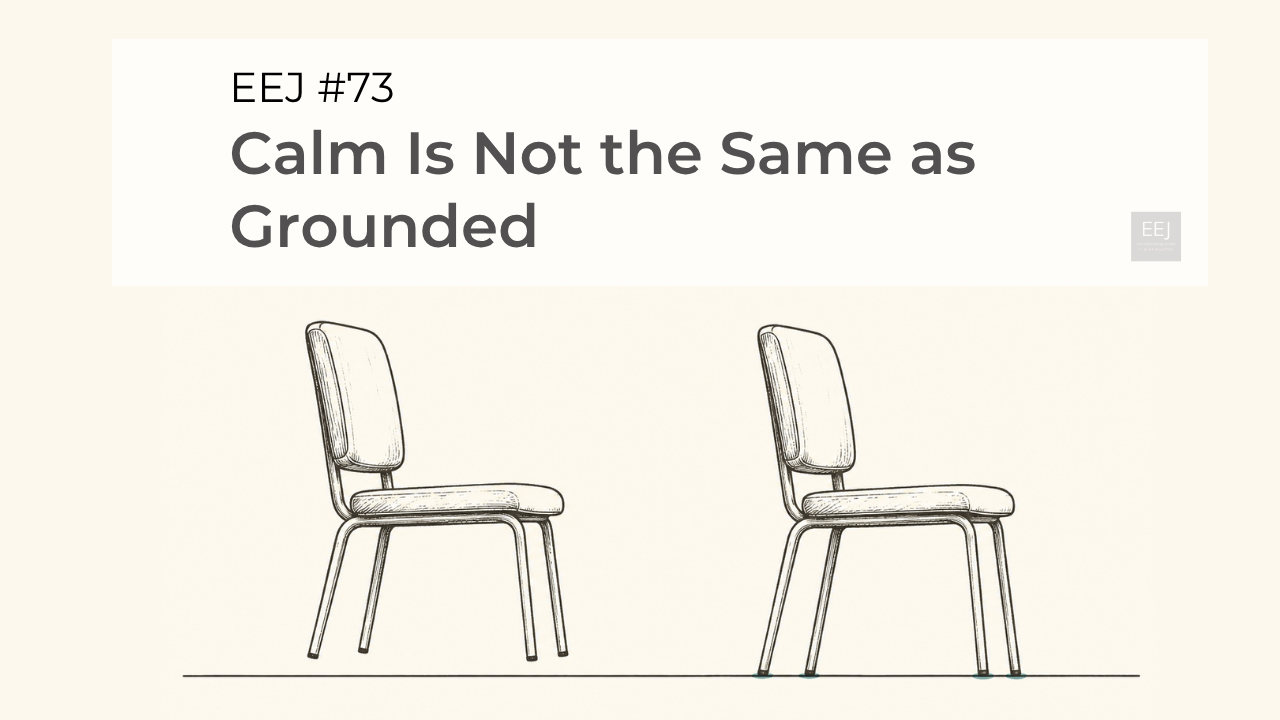
Calm Is Not the Same as Grounded
Niina Gullstén | Executive Energy Journal | Issue #73
Welcome to The Executive Energy Journal, where we explore a side of leadership few talk about—the subtle energy we have, live in, and how it impacts clarity, decision-making, and performance.
How EEJ works
- What's measurable: what research and observable mechanisms support
- What's unknown: where evidence ends, and interpretation begins
- What I do pragmatically anyway: the simplest reliable practice I use with clients
- Your role: take what is useful and leave the rest
In this issue:
- The difference between becoming calmer and becoming grounded
- The step many regulation practices leave out, and a two-minute landing for your team
1. Calm, yet not quite there
You did the breathing, and your shoulders came down. But there's a lightness in you that is not the good kind. Something floaty, as if you're half a centimetre above the chair rather than on it. Focus keeps sliding off whatever it should be on.
So the calm did arrive, but something else didn't.
This is not a failure of the breathing. Slow, deliberately paced breathing can reduce activation, and that is what has happened. When the calm arrives and something is still missing, the usual conclusion is that you need more of the same, done better or held longer.
I think the conclusion needs correction, because activation is no longer the missing variable.
2. What happens when you go beyond regulation
Here's the other end, and you may recognise it from the good days.
Things come up and you take them one at a time, going through what needs going through, without the sense that everything arrives at once. What you say has more bass in it, and you did not put it there. You sit with people whose values are nothing like yours and stay perfectly able to talk to them, because their difference does not press on you.
Any of these can naturally also be related to something else, like sleep, thyroid, the specific week you're having. This is not a diagnostic, it's my observations and my clients' reports.
What I think is different in that state is not just the arousal level, but that you are also resting on something.
I mean that fairly literally, and I am aware of how it sounds. What people describe when they get there is a feeling of solidity, contact with something that supports and takes part of the weight. The direction is downward, and the felt support arrives from below. They don't say that they have "stabilised themselves."
In practice, what I do is this. I move my attention downward, below my feet, to a point roughly 30 centimetres under my feet. Then I breathe in and out of there, as if not from my lungs, but from that point.
Travelling down gets you to the right place, but the breathing creates a relationship of sorts: something goes out, and something comes back.
I don't think of grounding as an advanced form of calming down. Calming changes what is happening inside you. Grounding changes what you are orienting in relation to. They do not sit on the same scale.
3. What the instruments measure
There's a lot of research close to this topic and almost none (that I've found) is about what I'm talking about.
Two findings are relevant here anyway, and I offer them as analogy rather than evidence.
A) Contact.
In a 1994 study, when a standing person, with eyes closed rested a fingertip on a fixed surface with less than a one newton of force (far too light to hold anyone up), their postural sway dropped. And it dropped a lot, as much as if they had gripped the surface properly, and as if they had opened their eyes to see the room. It was later confirmed that this is not mechanical support: block the sensations in the fingertip and the effect disappears.
In other words, contact can stabilise by informing rather than by mechanically supporting. The fingertip is not bearing weight, it is telling the person's system where the system is, relative to something that is not moving. That turns out to be enough.
That is what the anchor point is in my sequence. Not something you need to put weight on. A light contact with something that isn't moving, where the contact itself is what does the work.
In the researchers' terms, the system is using haptic information from a fixed external reference. For the purposes of my work, I call it a relationship. So take the studies as an analogy for what I'm describing, not as direct evidence of it.
B) Gravity.
Gravity is the one constant every terrestrial animal has evolved inside, and we have dedicated organs for it. The brain estimates our orientation relative to gravity, and maintains internal models of gravity that help us perceive and predict movement.
This does not establish that the point below my feet is an external contact, or that anything passes between it and me. It does mean that downward is not an arbitrary direction. The nervous system is already continuously estimating orientation relative to gravity. My practice directs conscious attention along a reference the system already uses.
Pause. Before the next section, notice if you really feel your feet touching the floor or if you merely know they do.
4. Where the evidence stops
The touch studies measure physical contact and postural sway. The gravity research examines how the brain estimates orientation and predicts movement.
Neither tests what happens when a person places their attention below their feet. They do not tell us whether that point becomes a reference for the wider system, whether anything is exchanged through it, or why some people experience support arriving from below.
Those are observations from practice, not conclusions from the studies.
What the research does give us is a useful design principle: a system does not need to place significant weight on something to organise itself relative to it. Information from a stable reference can be enough.
That is the point at which the research ends and my own work begins.
5. The step after regulation
I need to be precise about the terms here.
In research, regulation is a broad category. Grounding is not one universally agreed physiological state. I use the words as working terms for two different moves.
Down-regulation changes how activated you are.
Grounding changes what you are orienting relative to.
This distinction matters because a person can become calmer while remaining entirely organised around themselves. The breathing slows. The shoulders release. The internal noise decreases. But the system is still carrying its own weight, monitoring its own state and attempting to stabilise itself from inside itself.
That is the floaty calm I described at the beginning.
Grounding adds a reference. In the sequence I use, attention moves below the feet and breathing establishes contact with that point. The experience changes from “I am calming myself” to “I am resting in relation to something”.
I cannot establish from research that something outside the person is literally responding. I can say that people regularly experience the movement as reciprocal: attention goes down, and solidity comes back.
The practical result is different from calmness. You do not merely feel better. You become more properly located.
6. Why stopping at regulation leaves the job unfinished
Most regulation practices end when discomfort decreases.
That is understandable. If the pressure has dropped, the technique appears to have worked. But reduced discomfort is a poor final measure of readiness.
The more useful question is: what can you do from here?
Can you hold disagreement without becoming internally displaced by it? Can you hear three competing demands and take them one at a time? Can you remain in contact with another person without leaning towards them, pulling away or losing your own position?
Regulation makes those capacities more available. Grounding gives them somewhere to operate from.
This is also why repeating the breathing does not necessarily solve the floatiness. You are applying more regulation when the missing variable is reference.
7. A two-minute landing for a team
You can use this at the beginning of a meeting, particularly after people have arrived from several different conversations.
Say:
“Before we begin, take a moment to arrive. Feel the chair beneath you and the floor beneath your feet. Let your attention move to a point about thirty centimetres beneath your feet. Keep breathing normally, but for three full breaths, imagine the breathing taking place from that point.
Then bring the purpose of this meeting to mind. What is the one thing that needs to be clearer when we leave?”
Allow people a few seconds to write down their answer. Then begin.
The first part reduces carryover. The second establishes a downward reference. The final question gives the settled system a direction.
There is no need to ask anyone to describe what they felt. This is preparation for the work, rather than a group processing exercise. If you try this with your team, I would be interested to hear what changed.
8. The takeaway
Do not discard regulation. It creates the conditions for everything that follows.
But do not ask a reduction in how activated you are to create a reference point by itself.
When calm still feels light, more breathing may not be the next step. Let your attention travel down. Establish contact. Then notice whether you are still holding yourself up.
The Quick Preview guides you through this move in about two minutes. If you have used it before as a calming practice, try it again and notice the precise moment when calming ends and contact begins.
Until Sunday in two weeks,
Niina
References
- Jeka, J. J., & Lackner, J. R. (1994). Fingertip contact influences human postural control. Experimental Brain Research, 100(3), 495–502. https://doi.org/10.1007/BF02738408
- Kouzaki, M., & Masani, K. (2008). Reduced postural sway during quiet standing by light touch is due to finger tactile feedback but not mechanical support. Experimental Brain Research, 188(1), 153–158. https://doi.org/10.1007/s00221-008-1426-5
- Lacquaniti, F., Bosco, G., Gravano, S., Indovina, I., La Scaleia, B., Maffei, V., & Zago, M. (2015). Gravity in the brain as a reference for space and time perception. Multisensory Research, 28(5–6), 397–426. https://doi.org/10.1163/22134808-00002471